
Berwyn Epoxy Flooring provides concrete grinding in Berwyn, IL, serving surrounding cities including Forest Park, Lyons, Brookfield, River Forest and Summit. Grinding is the first day of nearly every floor we have installed in 20+ years, and it is also a service on its own for owners who need a slab stripped, flattened or opened before another trade takes over.
We open every slab mechanically, with diamond grinders or a shot blaster, and we do not acid etch. That choice is the single biggest reason our coatings stay bonded, and it is the step most often skipped by kit floors and low bids.
On older floors, grinding is also how we learn what is actually on the slab. We scrape and test paint, sealers, adhesives and patches before quoting, and the proposal lists exactly what will be removed and what profile the slab will be left at.
Why Surface Preparation Decides the Floor
Coatings Only Grip What They Touch
An epoxy or polyaspartic coating bonds to whatever is directly beneath it. If that is old paint, a sealer, oil-soaked cream or a film of dust, the coating is only as strong as that layer’s grip on the concrete.
Grinding removes those layers and exposes clean, sound concrete. Most coating failures we are called to fix trace back to preparation, not to the coating itself.
Surface Profile and the ICRI CSP Scale
The texture left on concrete after preparation is described on the ICRI concrete surface profile scale, from CSP 1, nearly smooth, to CSP 10, very rough. Coating manufacturers specify the range their products need.
Thin coatings need a lighter profile, while thick mortars and overlays need a deeper one. We choose the tooling and method to land in the right range and check the result against reference chips.
Why We Never Acid Etch
Acid etching dissolves the surface paste unevenly and leaves salts that must be neutralized and rinsed. It does nothing to remove paint, sealers or oil, and the rinse water has to go somewhere. Mechanical preparation leaves a measurable profile, removes contamination and produces dry dust that is collected rather than wastewater sent toward a drain.
Grinding and Shot Blasting Methods
Diamond Grinding
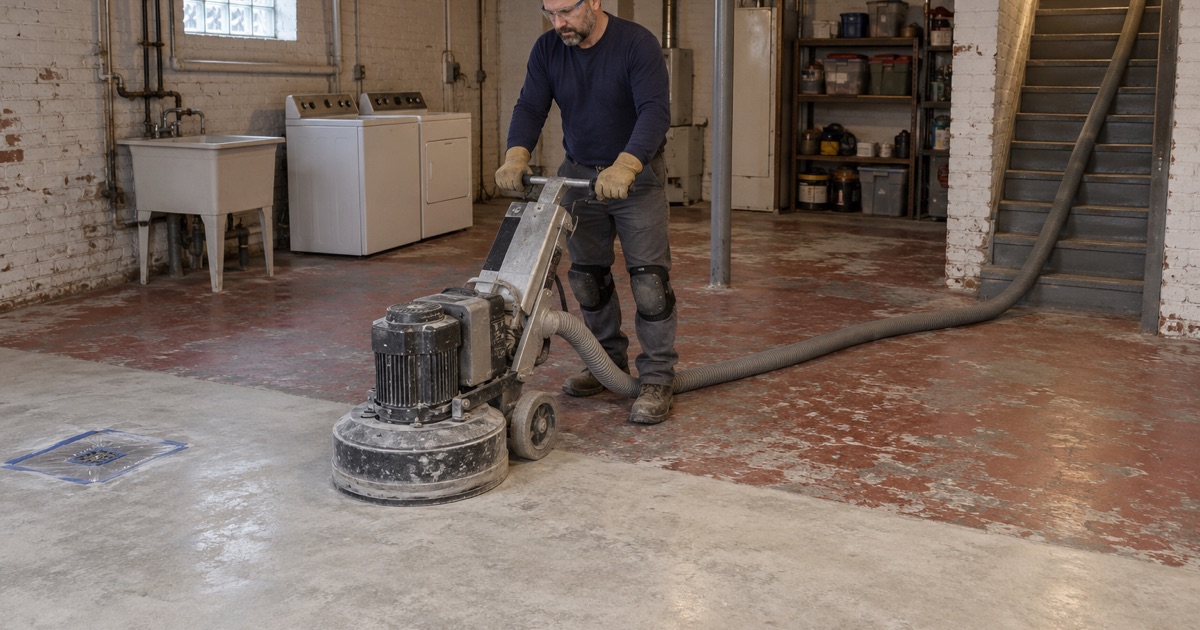
Walk-behind grinders spin diamond tooling against the slab, cutting off coatings and the weak top layer. Coarse metal-bond diamonds remove material fast, and finer tooling refines the surface.
Grinding is the best choice for flattening high spots and for slabs with paint, mastic or thick coatings. Edge grinders and hand tools reach corners, stairs and along walls.
Shot Blasting
A shot blaster throws small steel shot at the slab, opening the surface quickly and evenly, and recycles the shot through a vacuum. It is fast on large open floors such as warehouses and parking areas.
Shot blasting leaves a slightly rougher profile and does not flatten a floor the way grinding does, so the right method depends on the slab and the system going on it.
Dust Collection
Concrete dust contains fine silica, so dust control matters for workers and for anyone in the building. Our grinders and blasters run with industrial dust extractors fitted with HEPA filters.
The dust is bagged and taken away. Nothing is washed down a floor drain, out the garage door or into the alley.
Removing Old Layers From Older Slabs
Paint and Old Coatings
Basement and garage floors in older homes often have several coats of paint, each applied over the last. Grinding removes them all, down to the concrete, so the new floor is not tied to paint that may already be letting go.
Failed epoxy coatings come off the same way. Thick, well-bonded coatings may need coarser tooling and more passes.
Mastics and Adhesives
Tile and carpet adhesives leave a sticky or brittle layer that clogs ordinary tooling. We use tooling designed for adhesive removal and, where needed, scrape before grinding.
Older black cutback mastics can contain asbestos. We test them first and, if a test is positive, the removal follows the required procedures before any grinding.
Oil Stains and Contaminated Concrete
Garage and shop floors often have oil soaked deep into the concrete. Grinding removes the surface layer, and remaining stains are treated with degreasers or primers made for oil-contaminated concrete. If contamination is too deep for preparation to address, we tell you before a coating is quoted, because oil will keep pushing up into the finish.
Flattening, Leveling and Repairs
Flattening High Spots and Lips
Cracked slabs often have one side higher than the other, and old patches can stand proud of the floor. Grinding takes those lips down so the new floor does not show ridges or trip edges. For metallic epoxy and polished concrete, flatness matters even more, because those finishes reveal every high and low spot.
Filling Cracks and Spalls After Grinding
Once the slab is ground, cracks and spalls are easier to see and repair. We fill them with epoxy or polyurea repair materials and grind the repairs flush. This is also when we judge whether any cracks show movement that a coating cannot bridge.
Preparing for Other Finishes
Grinding is not only for epoxy. It prepares slabs for self-leveling underlayment, tile, vinyl plank, polished concrete and new coatings of every kind. If another trade is installing the final floor, we prepare to the profile their product calls for and leave the slab clean and ready.
Moisture Testing After Preparation
Testing the Opened Slab
Moisture tests are most accurate on prepared concrete. After grinding, we test with ASTM F2170 relative humidity probes or an ASTM F1869 calcium chloride kit, depending on the slab and the product. The readings are compared with the ASTM F710 guidance and the manufacturer’s limits before a coating system is chosen.
When the Readings Are High
If moisture is above what a standard coating can tolerate, a moisture-mitigation primer is applied directly to the ground slab. That primer depends on a properly opened surface to bond. We explain what the readings mean for your floor and your warranty before anything else is applied.
- 20+ Years Coating Floors
- Moisture Tested Before Quoting
- Free Written Estimates