
Berwyn Epoxy Flooring installs basement floor epoxy in Berwyn, IL, serving surrounding cities including Forest Park, Lyons, Brookfield, River Forest and Summit. In 20+ years of coating basement slabs we have found that the color is the easy decision, and the hard ones are about what is on the concrete, what is coming up through it, and where the water goes.
Most basement slabs in this area are old. Many sit under homes built before 1940, carry several generations of paint and patches, and were poured without any vapor retarder beneath them. Every basement job we take on starts with testing those conditions, and moisture testing is a line item in the proposal, not an upsell after a floor blisters.
The proposal also names the products, the coats and the finished thickness, and on a home job it comes with a written contract and the Illinois consumer-rights pamphlet required by the Home Repair and Remodeling Act. If the slab needs repair or a water problem has to be solved first, we say so before quoting a coating.
Moisture Comes First in a Basement
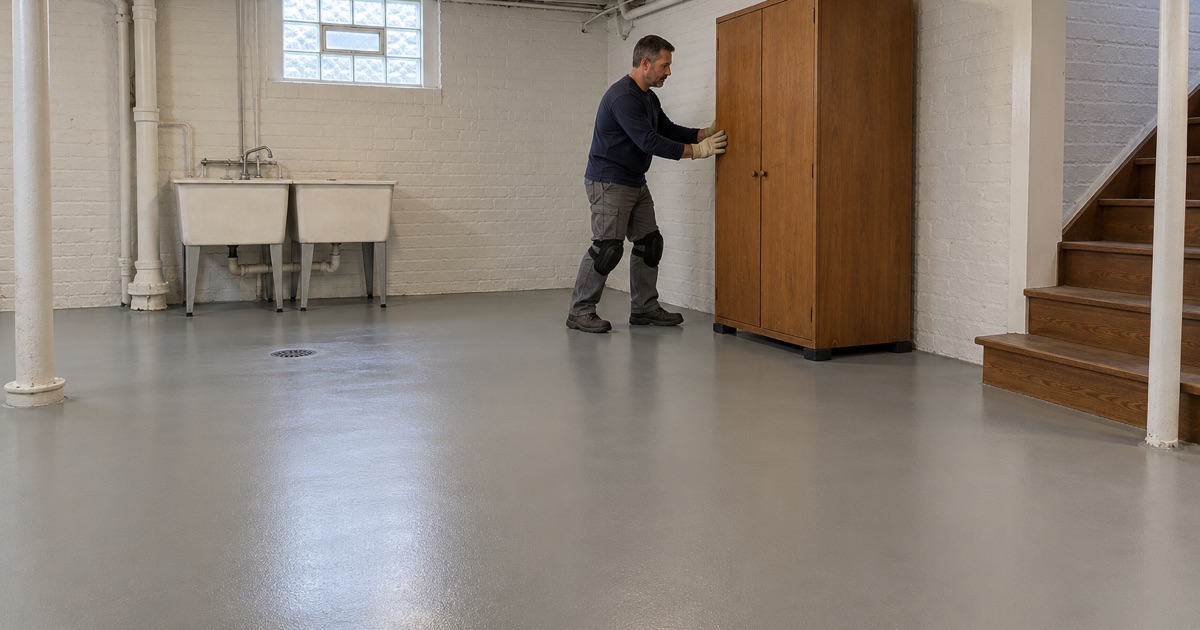
Why Basement Slabs Are Always a Little Damp
A basement floor sits directly on soil that holds water, and older slabs have no plastic sheet under them to slow vapor. Moisture moves up through the concrete constantly, in amounts that rise after rain and fall in a dry spell.
A bare slab lets that vapor escape at the surface. A coating seals the top, and if the vapor pressure underneath is higher than the coating can resist, it pushes the film up into blisters that spread across the floor.
Three Tests, Three Different Answers
The plastic sheet test in ASTM D4263 is a quick screen: a square of plastic taped to the floor that shows whether moisture collects under it. It tells us something is moving, but not how much.
For numbers we use ASTM F2170 relative humidity probes set into the slab or an ASTM F1869 calcium chloride kit that measures emission at the surface. The limits we compare against, such as 75 percent relative humidity or 3 pounds per 1,000 square feet per day, come from ASTM F710 and the manufacturer’s data rather than from the test methods themselves.
Moisture-Mitigation Primers
When readings run above what a standard epoxy tolerates, a moisture-mitigation primer goes onto the ground slab before anything else. These primers are built to resist much higher vapor pressure and give the rest of the system a stable base.
They have their own limits, and we read the product data against your numbers. If a slab is beyond even a mitigation primer, we tell you plainly that a coating is not the right floor for that basement.
What Old Basement Floors Are Hiding
Paint, Patches and Old Adhesive
A prewar basement often carries gray floor paint over red paint over sealer, with patched trenches where old plumbing was replaced and black mastic from a tile floor that is long gone. Each layer bonds differently, and none of them is a sound base for a new coating.
We scrape and test the layers to understand them, then grind everything down to bare concrete. Older black mastics can contain asbestos, so if we find one, it is tested before any grinding starts.
Efflorescence and Salt Deposits
White, powdery deposits on a basement floor are efflorescence, salts carried up by moisture and left behind when it evaporates. They show where vapor is most active, often along cracks, near walls and around old patches.
We grind efflorescence off and note where it was, because those are the areas that need the closest moisture reading. Coating straight over it traps the salt under the film and almost guarantees a bond failure.
Hydrostatic Pressure and Cracks
When the water table rises after heavy rain, groundwater can push up against the underside of the slab. That hydrostatic pressure forces water through cracks and the joint where the floor meets the wall, and no floor coating can hold it back.
Cracks that weep water are a drainage problem, usually solved with drain tile and a sump pump. We point you to that work first and come back to coat once the slab is dry.
Drains, Sewers and Backups in Berwyn Basements
Combined Sewers and the Floor Drain
Berwyn’s sewers are combined, so storm water and household waste share the same pipes. In a heavy storm those pipes can fill, and water backs up through the lowest opening in the house, which is usually the basement floor drain.
A coating does not stop that, and we say so plainly. What we can do is keep the drain fully open, slope the finished floor so water still reaches it, and make sure the coating ends cleanly at the drain body.
Overhead Sewers and Backflow Valves
An overhead sewer conversion or a backflow valve is what keeps sewage from coming up through a Berwyn basement drain, and the city has offered help with both. If you are planning either, we recommend finishing that plumbing work before the floor goes down.
Installing a backflow valve or overhead sewer usually means cutting a trench in the basement floor. That trench has to be backfilled, patched and cured before it can be ground and coated with the rest of the slab.
Coating After a Backup
A basement that has taken sewer water needs cleaning and disinfection, and then time to dry before any testing. Old paint that sat under contaminated water usually has to come off, and grinding removes the contaminated surface along with it.
Only after that do we take moisture readings and choose a system. Sealing a damp or contaminated slab under fresh epoxy only traps the problem in place.
Choosing the Right Basement Floor System
Flake, Solid Color and Metallic Finishes
A full vinyl flake floor is the most popular basement choice for laundry rooms and workshops, since the chips hide dust and lint between cleanings. Solid colors suit utility areas, and metallic epoxy turns a finished basement into a showpiece room.
All three sit on the same foundation of grinding and moisture testing. The finish is chosen last, after the slab has told us what it can carry.
Laundry Areas, Gyms and Workshops
Around washers and utility sinks we add a fine anti-slip additive so wet spots are less slick. Home gyms usually get rubber mats in the lifting area over a coated floor that is easy to clean around them.
Workshops benefit from a harder topcoat that resists dropped tools and solvent drips. We match the topcoat to the use of each room rather than putting one product down across every space.
Radon and the Coated Floor
A floor coating does not reduce radon, and we never present it as if it does. Radon mitigation in Illinois requires a license from the Illinois Emergency Management Agency.
If your home has a mitigation system, or one is planned, we coat around the suction point and seal it properly so the coating works with the system rather than around it.
Our Step-by-Step Basement Floor Epoxy Process
Step 1: Inspection and Testing
We check old coatings, cracks, drains and signs of past water, then test moisture and write a proposal naming the system and thickness. If a drain, backflow or seepage problem has to come first, the proposal says so.
Step 2: Clearing and Grinding
The room is cleared, laundry machines are moved, and the slab is ground to bare concrete with dust extraction running the whole time. Stairways and doors to the rest of the house are sealed with plastic before the grinder starts.
Step 3: Repair and Primer
Cracks and old trenches are filled and ground flush, and a moisture-mitigation primer is applied if the readings call for one. The drain body and sump rim are masked so the coating ends cleanly at each.
Step 4: Coating and Hand-Off
The base, broadcast and topcoat go down, and you get written times for foot traffic and moving appliances back. In a shared building, those times go to the owner and tenants together.
- 20+ Years Coating Floors
- Moisture Tested Before Quoting
- Free Written Estimates