
Berwyn Epoxy Flooring handles concrete floor repair in Berwyn, IL, serving surrounding cities including Forest Park, Lyons, Brookfield, River Forest and Summit. Over 20+ years of coating slabs, crack, spall and patch repair has been part of nearly every job, because almost no floor in this area arrives ready for a coating.
Repair is where we are most direct. We read every crack and every old coating before quoting, and when a slab has moved too far for a repair to hold, we tell you it needs to be replaced before money goes into a coating that would crack right along with it.
The proposal lists each repair as its own line, with the material we will use, so you can see what the floor needs before it gets a finish and compare it fairly against another quote.
Reading the Cracks in a Slab
Shrinkage Cracks
Nearly every concrete slab cracks as it dries and shrinks, and those thin random cracks are normal. In a stable slab they do not grow much, and they can be routed open, filled with a rigid epoxy or polyurea filler and ground flush with the surrounding floor.
Once filled and coated, a shrinkage crack in a sound slab rarely shows again. We check each one with a straightedge to make sure both sides sit level before we call it a simple repair.
Cracks That Signal Movement
A crack with one side higher than the other, a crack wider at one end, or a slab section that shifts when a car rolls over it all tell us the ground beneath has moved. That can come from soil settling, frost, poor compaction when the slab was poured, or water washing out the base.
Filling those cracks with a rigid material only moves the problem. We explain what is causing the movement and whether the slab can be stabilized or needs to be replaced.
Control Joints and Construction Joints
Control joints are the cuts placed in a slab so it cracks along a straight line instead of randomly. Over time their edges chip, especially under hard wheels, and debris fills them.
We clean joints out, repair broken edges with an epoxy mortar, and fill them with a semi-rigid joint filler. In a slab that still moves seasonally, we may keep a joint open through the coating so the floor can move without cracking the finish.
Surface Damage on Garage and Basement Floors
Spalls and Chipped Edges
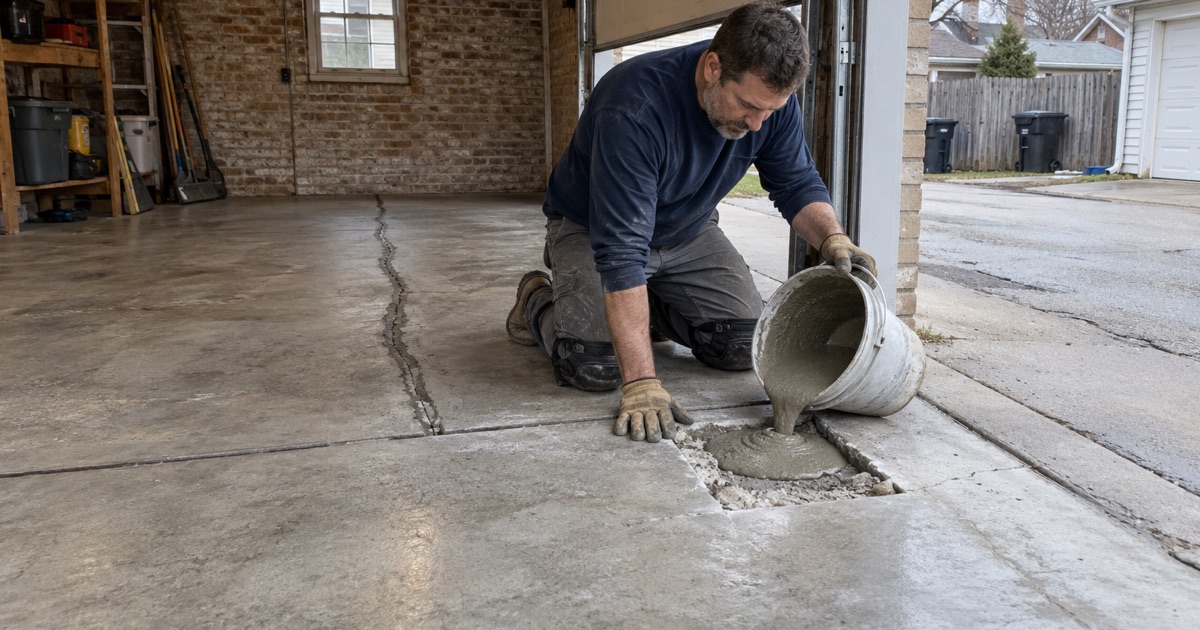
Spalls are areas where the top of the concrete has broken away in chunks, often at joints, around the garage door and where steel jacks or snow shovels have struck the surface. Left alone, they collect water and salt and keep growing.
We saw-cut or grind the edges of the spall back to sound concrete, fill it with an epoxy or polymer mortar, and grind it flat. The repair is often harder than the original concrete around it.
Salt Scaling Near the Door
Scaling is a thin layer of the surface flaking away, usually in the first few feet inside a garage door. It comes from rock salt and calcium chloride brine carried in on tires, soaking into the slab and going through freeze-thaw cycles all winter.
We grind off the loose surface, fill the pitted area with a repair mortar and then coat the floor so the salt water sits on top. Without a coating, a repaired area will usually scale again.
Pop-Outs, Pits and Rough Patches
Small cone-shaped holes where a piece of aggregate has popped out of the surface are common in older slabs. Pitting can also come from years of acid cleaners or spills.
Those are filled with a fast-setting patch material during floor preparation and ground smooth. They are minor on their own, but a coating applied over open pits traps air that bubbles through the finish.
Old Repairs in Older Homes
Plumbing Trenches and Old Patches
Basement floors in older homes often have trenches where cast iron drains were replaced or new plumbing was added. Those patches may sit higher or lower than the slab and may be a different mix that absorbs coatings differently.
We grind high patches down, fill low ones, and make sure the patched concrete is fully cured. If an overhead sewer or backflow valve is planned, we recommend finishing that work first so the floor is only patched once.
Paint, Adhesive and Leveling Compounds
A prewar basement may carry paint, old tile adhesive and thin leveling compounds that were never meant to be coated over. Many of those layers are weaker than the concrete and will let go once a new coating pulls on them.
We test each layer for bond and remove what does not pass. Old black mastics are tested for asbestos before any grinding begins.
Floors That Took Water
Slabs that have flooded, especially from a sewer backup, can have contamination and salt deposits in the surface. Repairs on those floors start with cleaning and drying, and then grinding off the affected surface.
Only after the slab is clean and dry do we fill cracks and patch damaged areas. Repairs made over contaminated concrete do not bond well and can fail under a coating.
When Repair Is Not Enough
Slabs That Need Replacing
Some floors are past repair: large sections that have sunk, heaved or broken into pieces, slabs with severe scaling across most of the surface, or garage floors that have tilted away from the drain. Coating those floors would be a waste of money.
We tell you plainly when a slab should be replaced, and we can advise on what the new pour should include, such as a vapor retarder meeting ASTM E1745 if the slab will be coated later.
Waiting for New Concrete to Cure
New concrete needs time to cure and dry before it can be coated, typically measured in weeks rather than days. Coating too early traps moisture and leads to blistering. We test the new slab for moisture before scheduling the coating rather than relying on the calendar alone.
Permits, Inspections and Property Sales
In Berwyn, contractors need a city license and bond before a permit can be issued, and a full slab replacement is the kind of work that typically involves the permit office. A property sale also triggers a city compliance inspection, which is when many sellers first learn about a damaged garage floor.
We confirm what the city requires for your project before work starts. On home jobs you also get a written contract and the consumer-rights pamphlet the Illinois Home Repair and Remodeling Act requires.
- 20+ Years Coating Floors
- Moisture Tested Before Quoting
- Free Written Estimates